








Key Highlights
- Partnered with a leading utility asset management provider to deliver AI-driven inspection and mapping for power and telecom infrastructure.
- Designed deep learning workflows for pole, wire, crossarm, and transformer detection, boosting inspection scalability and accuracy.
- Leveraged Unity-based synthetic data generation to expand datasets by 10x and enable robust model training across diverse environments.
- Established offshore teams to provide continuous support, iterative improvements, and scalable training pipelines for cost-effective delivery.
Problem Statement
01
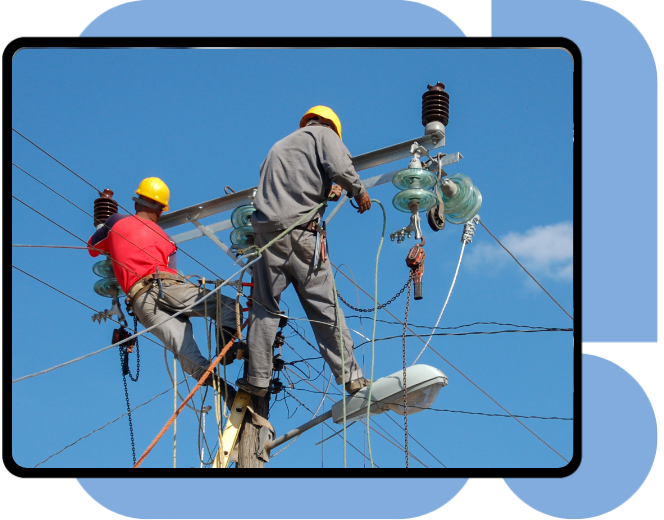
Manual Inspection Bottlenecks: Utility pole inspections required extensive manual effort. Technicians had to label images and identify components and mark them using annotation software. This process was time-consuming, error-prone, and difficult to scale across large networks.
02
Data Limitations: Real-world pole datasets were limited in both scale and diversity, making it difficult to train robust AI models that could generalize across varied environments, lighting conditions, and asset configurations.
03
Component Complexity: Utility poles consist of multiple interconnected elements—wires, crossarms, transformers, and more. Accurately detecting and classifying each component, along with their keypoints (e.g., wire joints, guy wires), posed a significant computer vision challenge.
04
Network-Level Challenges: Identifying special conditions such as double wood poles (buddy poles) required network-wide analysis, which was beyond the capabilities of traditional inspection workflows.
Solution Overview
01
AI-Powered Computer Vision Models: Built deep learning pipelines for keypoint detection and instance segmentation, evaluating backbones like ResNet and Swin Transformer for production-grade scalability.
02
Synthetic Data Generation: Generated synthetic datasets using Unity, multiplying data scale by 10x with variations in lighting, weather, and pole structures.
03
Post-Processing for Reliability: Designed intelligent filtering logic to reduce false positives, enhancing inspection reliability and reducing manual rework.
04
Scalable Training Pipeline: Deployed scalable pipelines in PyTorch and MMDetection for rapid experimentation, validation, and fine-tuning at scale.
05
Agile Support: Offshore teams ensured continuous training, monitoring, and iterative improvements, aligning with evolving operational needs.
Business Impact


About The Project
OptiSol collaborated with a leading provider of utility asset management solutions to deliver AI-powered inspection systems for telecom and power infrastructure. Using keypoint detection and instance segmentation, the models identified poles, wires, transformers, and crossarms, while also tagging specific connection points such as guy wires and joints.
With PyTorch and MMDetection at the core, the solution integrated large-scale training pipelines and systematic fine-tuning. To address real-world data gaps, Unity was used to generate high-quality synthetic datasets, ensuring robustness in varied lighting, backgrounds, and asset conditions.
This approach empowered faster, more reliable inspections across utility networks, reducing manual intervention while enabling scalable, data-driven infrastructure management.
FAQs:
How did you address the challenge of limited training data?
We used Unity to create a large-scale synthetic dataset, increasing training data volume by 10x. This allowed us to train models that generalize better across different lighting conditions, asset configurations, and environments.
What technologies were used in the solution?
We leveraged PyTorch and MMDetection for model training and fine-tuning. Unity3d is used for synthetic data generation. Our deep learning pipeline combines instance segmentation, keypoint detection, and custom post-processing logic.
What was the role of the offshore team?
The offshore team is providing continuous support in model training, data augmentation, and performance evaluation enabling cost-effective delivery and iterative improvements in detection accuracy and efficiency.
How did we handle the false positives?
We implemented post-processing conditional logic to filter out unlikely or incorrect detections, significantly reducing false positives and increasing the accuracy.
How does this impact utility companies operationally?
It enables faster, more accurate inspections, reduces dependency on manual inspection, and improves resource planning, leading to operational efficiency and cost savings across asset management workflows.
Testimonials of Our Happy Clients


Ken Kisner
Global Head of Digital R&D


My experience has been incredibly positive. They were incredibly easy to work with, even with changing requirements.
They are incredibly competitive, but are only a fraction of the cost of US companies.
They are definitely the most professional of the foreign companies that we were looking into.

Nyswyn K.
Director of Software Development

Our journey with OptiSol has been nothing short of remarkable. For over 7 years, we have partnered with them on our digital transformation, and the results have been truly transformative.
Over the years, we have come to trust OptiSol Business Solutions as a reliable and strategic partner.


Al Bagiro
CTO, Auto Insurance Company

The AI engine was completed on time and trained to 90% accuracy. Their eagerness to learn new knowledge impressed us.
Their team is large to handle multiple projects at once, and likes to resolve challenges as well as learn new things. They also welcome regular communications, and of course, needless to say, develop everything in sprints.

Dan Talken
Founder, CEO, & CTO, My Equipment Library, LLC

OptiSol Business Solutions has shown youthful skill and dedication to the projects. Moreover, they have been quick to implement their solutions without sacrificing the quality of each platform.
We’re constantly impressed with their speed and quality of the development that they achieve on a consistent basis.

Dr. A.K Pradeep
CEO MachineVantage

Exceptional Collaboration and Expertise - A Top-Notch Partner for AI, ML, and Digital Applications.
I have had the privilege of working with an exceptional team of professionals from India on numerous AI, ML, and digital application projects. Their expertise in these domains is remarkable, and they consistently impressed us with their knowledge, resources, and innovative approach.

Rick Tigges
CFO, Bemodo

They are very responsive and able to shift focus quickly as we have needed it for business reasons.
OptiSol Business Solutions has been great at documenting the timeline of the project. They were very responsive and were able to shift focus quickly, as well. They discuss what they’re working on without any issues. So far, there’s no need to improve their service.