


In short. Generic software was the right answer when building meant a large team and a roadmap you then had to own. That arithmetic has changed, and most companies have not repriced. The thing that trips people up is what they picture when they hear build, which is a worse copy of the product they already license. A purpose-built application with agents in it has fewer screens than the one it replaces, because most of those screens exist to collect what an agent can now go and get.
A CIO I spoke with this year had a renewal in front of her. Six figures, three weeks to decide, and a platform her team had used for nine years. She said what everyone says at that point, which is that they already pay for a system that does this.
They did. The question that changed the conversation was a different one. How much of your process did you change to use it?
She thought about it and then started listing things.
You bought generic because building was the more expensive mistake
For twenty years the calculation was straightforward. A licensed application cost a subscription. Building one cost a team, a runway, and a product you would be maintaining long after the people who built it had moved on. Generic won on arithmetic, and it usually deserved to.
The compromise came attached. A licensed application encodes somebody else’s idea of how the work goes, and where your process differed you bent it. Most organizations have carried that bend for so long it reads as normal now. It shows up as the spreadsheet that lives alongside the system, the approval that happens in email because the workflow engine could not express it, and the phrase we do it that way because the system needs it.
The tell. A spreadsheet that lives alongside the system, an approval that happens in email because the workflow engine could not express it, and a step people perform because the software expects it. Each one is a place where your process was the thing that moved.
Nobody priced that compromise, because there was no alternative to price it against.
This line has moved before
It is worth remembering that the build-versus-buy line is a price. Prices move, and this one has moved at least once in living memory.
Through the 1980s and 1990s, large organizations ran bespoke systems written in-house because nothing off the shelf fitted. Packaged enterprise software won the following two decades by making that bespoke work look indefensibly expensive, and it was right. The economics of writing and maintaining your own had become terrible relative to configuring somebody else’s.
So the industry has already watched this axis swing once, hard, and reorganized itself around the new price. That history is the reason to treat the current position as a calculation, and to check it on a schedule.

Two things moved, and the second matters more
The capability arrived first, and it got most of the attention. The economics moved second, and that is the one that changes a decision.
A frontier model under license can read a document, reconcile two records and draft a decision, which used to be the expensive part of any line-of-business application.
Then the cost of putting that capability into a workflow collapsed. McKinsey’s work on agent economics this year puts a single-agent workflow in the range of twenty to thirty thousand dollars to build, with cost per completed run falling from around seventy-eight dollars at a hundred runs to two or three dollars at ten thousand. Those are build and run numbers for one workflow, and they sit well inside what a mid-sized company already spends on seats for software that half fits.
So the line between buying and building moved. It did not disappear, and plenty of things still belong on the buy side. It moved far enough that a category of work which was permanently out of reach is now a quarter’s project.
Nobody is asking you to rebuild the admin console
The conversation usually stalls at this point, and what stalls it is a mental image.
When a CIO hears purpose-built, they picture rebuilding the product they already license. Screens, forms, tables, a workflow engine, user management, an admin console, reports. Years of work to arrive at a worse version of something they could have rented. They are right to reject that, and it is not what this is.
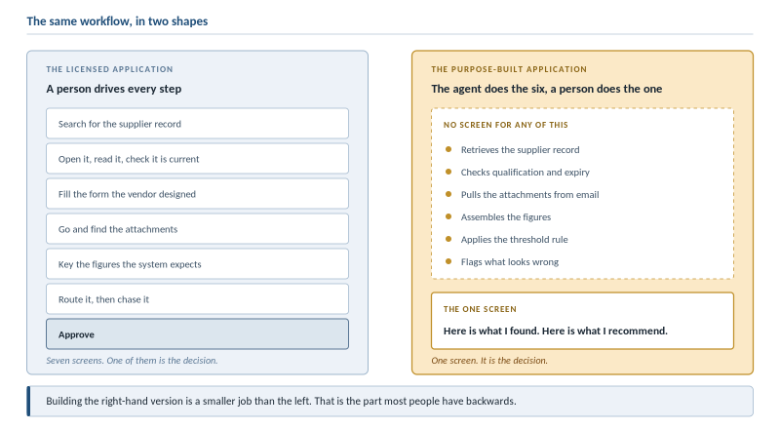
Look at what a licensed application is mostly made of. A person searches for a record, opens it, reads it, decides it is current, fills a form somebody else designed, goes and finds the attachments, keys in figures that exist elsewhere, routes the result and then chases it. Six of those steps are retrieval and assembly. One is a judgment.
Call that the six and the one. It is the ratio sitting inside most line-of-business workflows, and it is worth counting on your own before taking my word for it.
The screens exist because software could not do the six. It could only hold a place for a person to do them in a structured order. That constraint is what a workflow application is.
The surface that remains is small
The shape is different enough that the comparison to SaaS stops being useful. There is no form for the buyer to fill in, because the agent assembles what the form would have captured and presents it. There is no status view to go and check, because the thing that would have changed the status tells you. There is no report to run at month end, because the question gets asked in words and answered from the record.
What remains is a small surface: the points where a person decides, an exception that needs judgment, and a trail of what happened and why. That surface is genuinely small, and it is why building one of these is a smaller job than building the application it replaces, which is the part most people have backwards.
It is also why this is a workflow project rather than a platform project, as long as you hold a boundary.
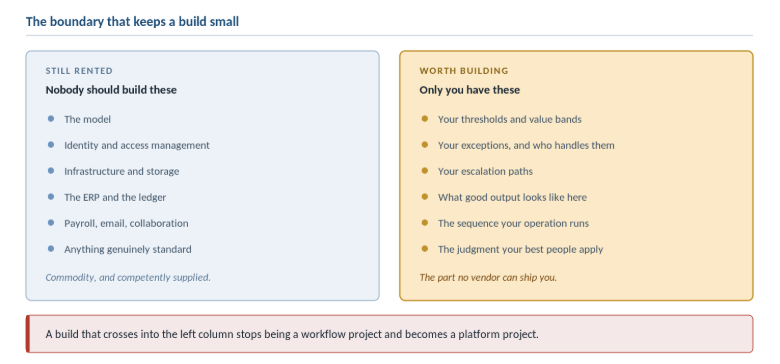
You keep renting the model, the identity layer, the infrastructure, the ERP and the ledger, and anything genuinely standard. You build the part that is only true of you: your thresholds, your exceptions and who handles them, your escalation paths, what good output looks like in your operation, and the judgment your best people apply without being able to explain it quickly.
That second list is the part no vendor can ship, and it is the part you have been working around inside somebody else’s product.
Where buying is still the right answer
This argument has a boundary and it is worth stating plainly, because a vendor who tells you to build everything is selling you something.
Where a process is genuinely standard, buy it. Payroll runs the same way in your company as in everyone else’s, and so do email, expense claims and general ledger accounting. The regulation is common, the practice is common, and a specialist vendor will do it better than you will while you sleep.
Where the process is yours and you have been bending it, that is the candidate. The clearest signal is a workaround you have stopped noticing.
Count the six and the one in your own worst workflow
Take the workflow you complain about most. Write down every screen a person touches to get one case through it, and mark each one as retrieval, data entry or decision.
Count the decisions. In most operations the answer is one or two, and everything else is a person doing what the software could not do when it was designed. That is your six and your one.
Then ask what it would cost to pay people to do only the decisions. That number is what the build is competing against, and it is usually a different conversation from the one about license renewal.
OptiSol is part of the Claude Partner Network, and builds Claude-powered applications and agents for enterprise workflows. Our forward deployed engineering teams work alongside business and technology teams to understand how the work actually runs before anything is built.


