
Executive Summary
Most enterprises don’t have an AI agent problem. They have a coordination problem
A verification agent checks eligibility. A document agent extracts fields. A decision agent scores the case. Each agent can perform its task effectively, yet the overall process can still depend on manual handoffs between them.
That is the problem AI agent orchestration is designed to solve.
Orchestration connects individual agents, enterprise systems, shared state, and approval points into one workflow that can execute from start to finish. The goal is not to make individual agents smarter. It is to make multiple agents work together as one operational process.
When agents operate in isolation, enterprises automate individual tasks but leave the handoffs between those tasks to people. The result is fragmented automation rather than an end-to-end workflow.
This article explains where isolated agents break down, what an enterprise orchestration layer needs to manage, and how a governed lifecycle moves multi-agent workflows from development into production.

The Problem Isn't the Agents. It's Everything Between Them
Every enterprise now has AI agents somewhere. Most of them were built to solve one task well, and most of them do. The primary failure point is often not agent quality, but the coordination between agents and enterprise systems.
A verification agent that confirms eligibility is genuinely useful. It becomes far less useful if its output sits in a queue for a human to manually re-key into the system the next agent reads from. That handoff, not the agent itself, is where the process slows down, and it’s invisible in any single agent’s own performance metrics, because from that agent’s point of view, it did its job correctly.
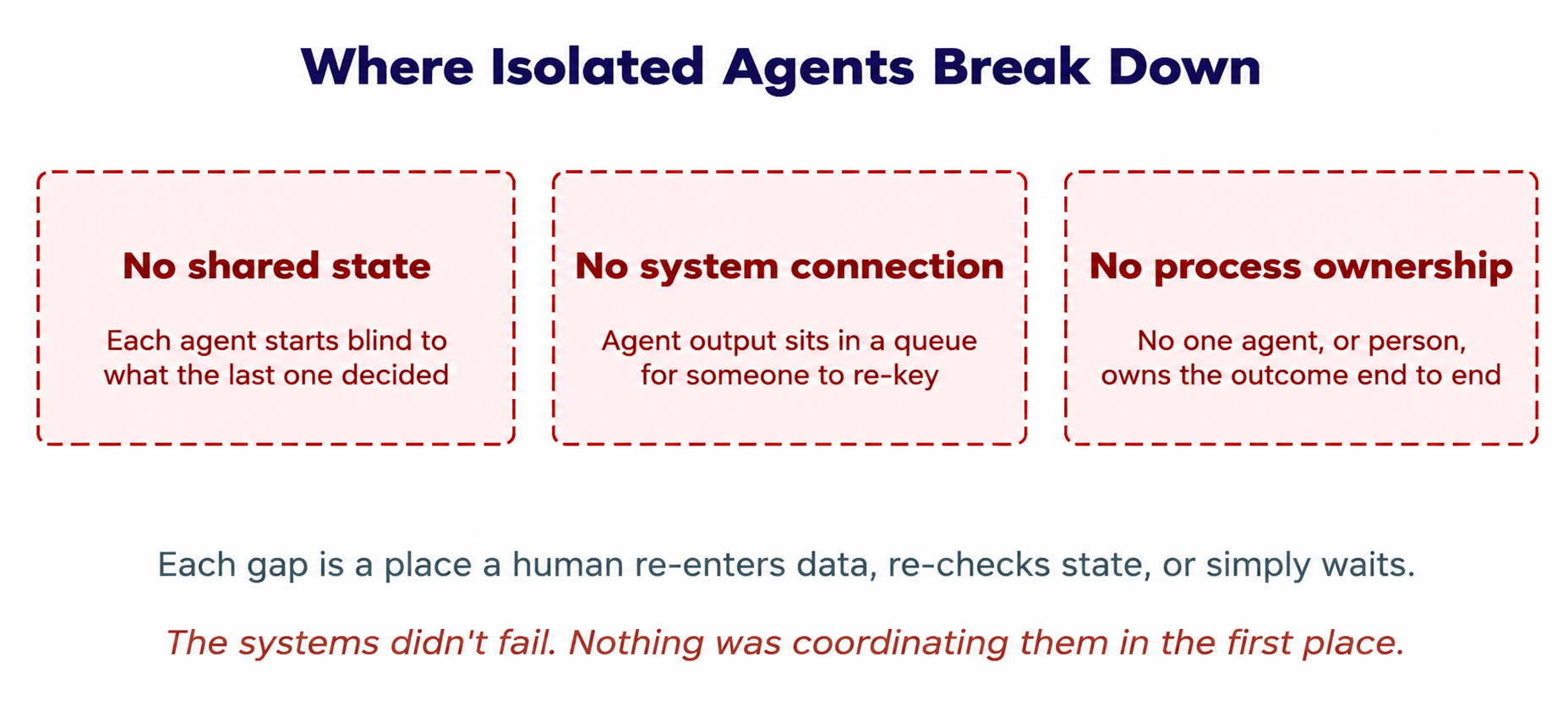
None of these three gaps show up as an agent failure. Each one looks, from the outside, like the process is “mostly working,” which is exactly why they’re so easy to leave unaddressed. An enterprise can have four well-performing agents and still have a broken end-to-end process, because performance was never the a constraint. Coordination was.
What Orchestration Actually Has to Do
Real AI agent orchestration across enterprise systems must solve three problems at once, not just one.
Shared state: Agents need access to the relevant state accumulated during the workflow, so downstream agents can act on previous decisions and outputs.
System connectivity: Agents need direct connections to enterprise systems such as EHRs, ERPs, CRMs, payer portals, and ticketing platforms so outputs can move to the next step without manual re-entry.
Multi-agent coordination: Enterprise workflows often require branching, parallel execution, or collaborative reasoning. Agent graphs and agent-swarm patterns support these different coordination models.
This is a different capability than agent frameworks typically built for. A framework optimized for building one good agent doesn’t automatically give you the coordination layer multiple agents need to run as one process. This can leave enterprises with multiple capable agents, but no coordinated end-to-end workflow.
One Lifecycle, Not Six Separate Tools
On the elsai platform, orchestration isn’t a single feature, it’s what runs underneath a full lifecycle. The platform’s customer-facing framing describes six stages: Build, Validate, Deploy, Monitor, Observe, and Optimize. At the platform level, elsai describes the lifecycle in six stages: Build, Validate, Deploy, Monitor, Observe, and Optimize. At the SDK level, the same lifecycle is grouped into four engineering stages: Build, Test, Deploy, and Monitor. Both describe one lifecycle at two levels of detail, not two different products. The distinction that matters either way: most enterprises don’t fail at building an agent. They fail at the stages after that, moving a working prototype into a production process that other systems and other agents can actually rely on.
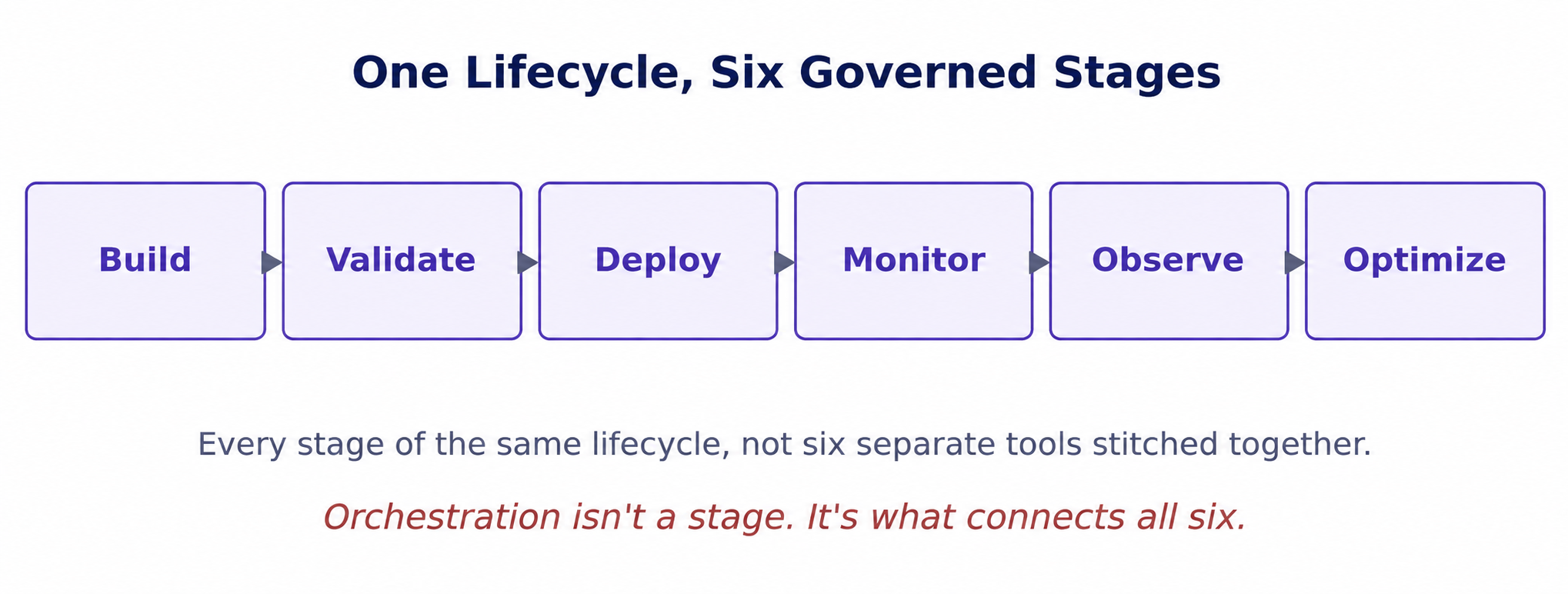
Build is where agents and workflows are actually assembled, using Agent Studio to design intelligent agents and workflows, a Workflow Designer to visually orchestrate the end-to-end process, a Skill Registry of reusable enterprise skills and actions, and a Knowledge Layer connecting enterprise data, documents, APIs, and graph-based retrieval, with Workflow Templates to accelerate development rather than starting from a blank canvas every time. Underneath that layer sits elsai’s Agentkit, the SDK that provides the actual multi-agent orchestration primitives: model-agnostic agents, native MCP support, agent graphs, and swarms, not just a way to build one agent at a time.
Validate and Deploy are critical transition points where enterprises determine whether an agent is ready for production. Monitor, Observe, and Optimize close the loop: every agent action, every tool call, every handoff between agents is traced, so a stalled process shows up as a specific, inspectable point in a specific workflow, not a vague sense that “the AI isn’t working.”
Not a Rebuild: Connect What You Already Run
elsai’s own positioning on this is direct: your model builds agents, elsai runs intelligent operations. The platform works alongside the AI ecosystem an enterprise already has, connecting models, frameworks, enterprise systems, and individual agents into one governed, end-to-end workflow, rather than asking a team to abandon the agents or the models they’ve already built. Keep building with the AI technologies your teams already know; the orchestration and governance layer is what coordinates and operates them together.
This is also the practical answer to agent sprawl, the point where an enterprise has accumulated enough individual agents that no one has a clear inventory of what each one does or how they relate to each other. An ai agent management platform approach doesn’t mean replacing those agents. It means giving them a shared registry, a shared execution trace, and a shared set of governance rules, so growth in the number of agents doesn’t become growth in the number of things nobody can account for.
How elsai's Orchestration Compares
It’s worth being specific here rather than making a general claim. elsai’s own internal comparison against three widely used agent frameworks, Google ADK, OpenAI’s Agents SDK (a separate product from elsai’s own Agentkit, despite the similar name), and LangChain/LangGraph, drawn from the Agent Development Lifecycle materials, lays out where the gap actually sits:
| Capability | Google ADK | OpenAI Agents SDK | LangChain / LangGraph | elsai |
|---|---|---|---|---|
| Multi-model support | Limited (Google-first) | OpenAI-first | Yes | Unified across OpenAI, Azure OpenAI, Bedrock, Gemini, LiteLLM, Ollama |
| Multi-agent orchestration | Yes | Limited | Yes | Built into Agentkit (graphs + swarms) |
| MCP support | Partial | Partial | Community | Native support |
| Prompt versioning | No | No | External | Instruction Manager, with approvals and runtime rollout |
| Production observability | Cloud-native only | Minimal | External tools | ARMS: cost, latency, traces, tokens |
| Enterprise governance | Limited | Limited | External | Audit trails, policy enforcement, runtime controls |
The pattern across every framework in that comparison is the same: each one can build an agent competently. The frameworks differ in how they approach multi-agent orchestration, observability, MCP integration, and enterprise governance. Enterprises evaluating an orchestration platform therefore need to distinguish between agent-development capabilities and the broader operational layer required to govern and operate multi-agent workflows in production. That gap, not agent-building capability itself, is the actual agent orchestration platform decision most enterprises are making right now, whether they’ve framed it that way or not.
What This Looks Like in Production
elsai’s own production workflows are built this way rather than described this way in the abstract. The healthcare revenue cycle work spans patient onboarding, prior authorization, patient engagement, and RCM analytics as connected workflows, not four unrelated agents that happen to sit in the same product. A tender-to-contract workflow for a multi-billion-dollar EPC procurement program is described as one governed workflow, explicitly framed around bringing agents, systems, and approval points together rather than automating isolated steps in that process.
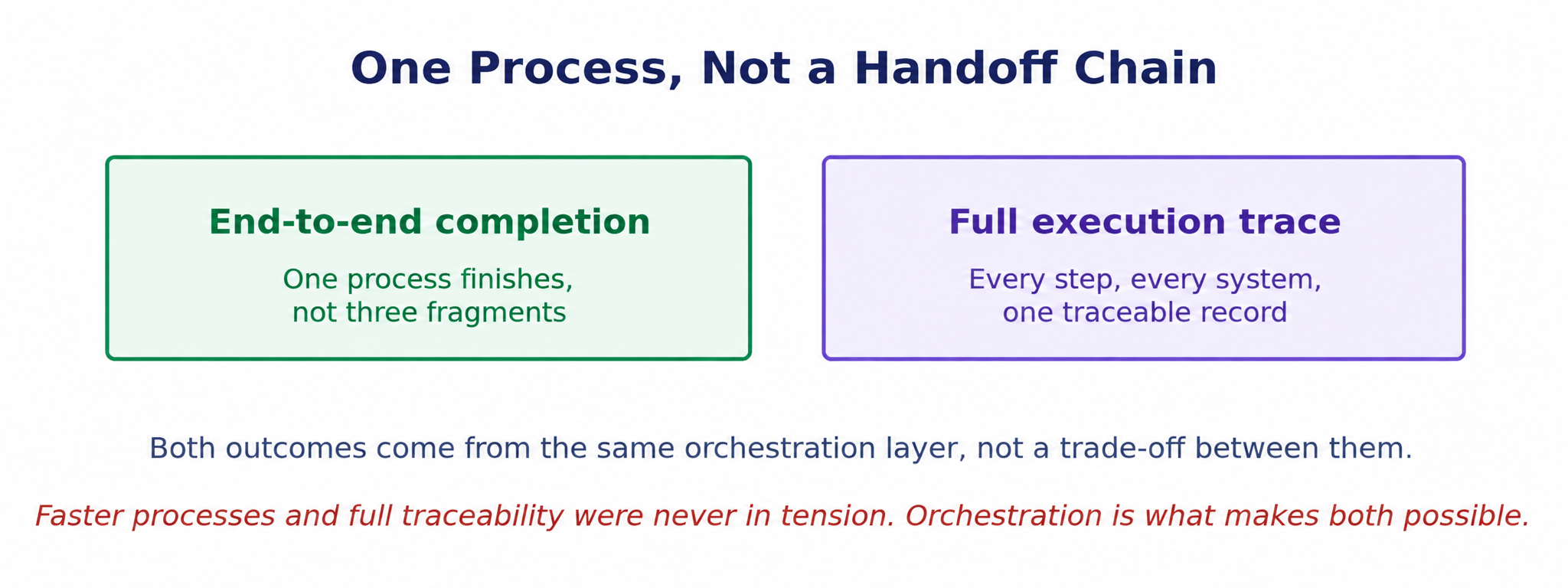
That’s the actual test of orchestration: not whether each individual agent performs well in isolation, but whether the process it’s part of finishes, end to end, with a record of how it got there.
Build the Workflow, Not Just the Agent
The number of agents is not, by itself, a measure of operational value. The more relevant measure is whether those agents coordinate effectively, interact with the required systems, and complete business processes end to end. They’re the ones whose agents are actually coordinating, sharing state, reaching the right systems, and finishing processes without a person stitching the gaps together by hand. That’s what separates an impressive demo from a production workflow.
This is what the elsai platform is built to give an ai agent platform buyer directly: Agentkit for model-agnostic agents, graphs, and swarms; Instruction Manager for versioned, governed prompts; Guardrails for policy enforcement before and after every model call; ARMS for full observability and traces across every agent action; and a Build-to-Optimize lifecycle that treats orchestration as the layer connecting all six stages, not a feature bolted onto one of them. See the full architecture at elsai.ai/enterprise-ai-platform.
FAQs:
What's the difference between an AI agent and AI agent orchestration?
An AI agent completes a specific task, extracting a field, checking eligibility, scoring a case. Orchestration is the layer that connects multiple agents, and the enterprise systems they touch, into one coordinated process: passing shared state between agents, routing output to the right system without manual re-entry, and giving the overall process, not just each individual agent, a traceable execution record.
Do I need to rebuild my existing agents to add orchestration?
No. A governed orchestration layer is designed to work alongside the models and agents an enterprise has already built, connecting them into coordinated workflows rather than requiring a rebuild. The orchestration and governance sit above the individual agents, not inside a rewrite of each one.
What's the difference between an agent graph and an agent swarm?
An agent graph coordinates agents through defined, often branching paths, useful when a workflow has clear conditional logic, such as routing to different specialists depending on a diagnosis. An agent swarm allows multiple agents to work on the same problem more collaboratively, useful when a task genuinely benefits from several agents reasoning together rather than one agent handing off to the next in a fixed sequence. Which pattern fits depends on whether the workflow’s logic is closer to a decision tree or a shared problem.
How is agent orchestration different from a plain workflow automation tool like an RPA platform?
Traditional workflow automation and RPA tools execute pre-defined, deterministic steps; they’re excellent at that but can’t make a judgment call an agent can, such as interpreting an unstructured clinical note or assessing denial risk. Agent orchestration coordinates AI agents that do make those judgment calls, while still connecting to the same enterprise systems a workflow automation tool would touch, so the two are complementary more often than competing: many production workflows use both, deterministic automation for the predictable steps, orchestrated agents for the steps that need reasoning.
What happens when an orchestrated multi-agent workflow fails partway through?
With full observability across every agent action, a failure shows up as a specific, inspectable point in a specific workflow run: which agent, which step, which tool call, and what the input and output were at that point, rather than a vague sense that the overall process didn’t work. That specificity is what makes root-cause analysis and recovery possible without re-running the entire process from scratch.
