
The acquisition is complete. But which system now holds the trusted version of the policyholder?
- After an acquisition, insurers often inherit multiple policy systems, claims platforms, customer identifiers, product definitions, and business rules that describe the same customer differently.
- This is where insurance data integration becomes critical. The challenge is to connect acquired data while preserving its meaning, relationships, history, and embedded business logic across the combined organization.
- In this blog, we cover five practical steps to assess source systems, build a canonical policyholder model, map legacy data, preserve business rules, and establish governance for analytics and AI.
- OptiSol’s Enterprise Data Modernization services help insurers turn fragmented post-acquisition data estates into a governed and trusted data foundation.
Why Insurance Acquisitions Create a Data Integration Problem
- According to PwC’s Insurance: US Deals 2026 Midyear Outlook, the US insurance sector recorded $29.6 billion in announced deal value across 191 disclosed transactions between December 1, 2025, and May 31, 2026.
- The harder work begins when the buyer combines policy systems, claims platforms, identifiers, schemas, and legacy databases.
- This is where insurance data integration becomes a business issue as much as a technology issue. Conflicting definitions can affect customer service, claims, underwriting, reporting, compliance, and future AI initiatives. A successful insurance M&A data integration program therefore needs a clear sequence: understand the source estate, establish common meaning, map the data, preserve embedded rules, and govern the target environment.
Step 1: Discover and Assess Every Policyholder Data Source
Assessment should happen before migration.
Build an inventory of systems, databases, pipelines, reports, and dependencies that contain or influence policyholder information. Review quality, completeness, relationships, lineage, and business rules.
McKinsey’s research on P&C core-system modernization highlights the challenge of modernizing core technologies while maintaining operational continuity.
A source assessment can reveal duplicates, conflicting values, undocumented relationships, hidden dependencies, and sources that require validation.
For insurance data integration, this helps teams decide what should move, change, remain, or require business review. In insurance M&A data integration, discovery also reduces the risk of designing the future state around an incomplete picture of the acquired environment.
Key question: Do we know every system that contains or influences policyholder data?
Step 2: Create a Canonical Policyholder Data Model
Once the source estate is understood, create a common business language.
A canonical model can define policyholder, policy, claim, coverage, beneficiary, address, payment, product, and their relationships.
System A: Customer_ID
System B: Party_Number
Canonical model: Policyholder_ID
A policyholder data platform can then connect policyholder, policy, claims, coverage, and payment information through shared definitions.
This is central to unified policyholder data because teams need agreed entity meaning before resolving duplicates or building a customer 360 view.
Canonical modeling also supports insurance data modernization by letting future acquisitions or source systems map to an existing enterprise model.
Key question: Do both organizations define policyholder, policy, claim, and coverage in the same way?
Step 3: Map and Transform Legacy Data
With the canonical model in place, define source-to-target mappings.
Mappings should capture field relationships, data types, transformations, code translations, historical records, validation rules, and exception handling.
A field called Product_Code may require translation before it reaches the target. A policy status such as “Active” may also carry different business meaning across two platforms.
This is why insurance data migration must preserve context rather than simply copy values. A controlled insurance data migration program should include reconciliation and validation so the target reflects the intended business meaning.
Two insurers may both have Coverage_Type while one defines it at product level and the other at policy level. That difference must be resolved before loading the target environment.
For insurance M&A data integration, source-to-target mapping creates a traceable bridge between acquired systems and the future-state model. It keeps insurance data integration explainable because teams can trace critical values from source to target and document each transformation.
Key question: Can we trace every critical policyholder field from source to target and explain what changed?
Step 4: Discover and Preserve Hidden Business Rules
A technically clean migration can still fail when important business logic disappears.
Rules may live inside stored procedures, ETL pipelines, SQL, application code, spreadsheets, documentation, and institutional knowledge.
Consider a claims classification rule that combines coverage type, loss code, policy status, and effective dates to determine routing. Moving the fields without preserving the rule can change operational outcomes.
McKinsey’s research on agentic AI and insurance core modernization discusses the decades of embedded business rules, custom interfaces, batch processes, and data semantics found in insurance core environments.
That is why insurance M&A data integration should make rule discovery a formal workstream. Capture each important rule with its source, dependencies, target representation, owner, and validation method.
This strengthens insurance data migration because teams preserve the logic that gives data operational meaning. It also keeps common fields consistent after consolidation.
For long-term insurance data modernization, preserving rules can reduce dependence on legacy applications and individual experts.
Key question: Have we captured the rules that determine how policy, claims, underwriting, and customer data are interpreted?
Step 5: Govern the Unified Data and Prepare It for AI
Governance should cover quality, lineage, ownership, access, privacy, auditability, data contracts, and stewardship.
The National Association of Insurance Commissioners’ Artificial Intelligence resource describes regulatory work around insurer AI governance, risk management, AI systems, and data used as inputs. Its Big Data in Insurance resource also addresses data quality, privacy, consumer protection, and transparency.
Governance belongs inside the architecture. A governed policyholder data platform can provide controlled access to trusted policyholder information for reporting, claims analytics, underwriting, fraud detection, customer intelligence, and AI applications.
This is where insurance data modernization creates value beyond the acquisition. The organization gains reusable definitions, traceable data, clearer ownership, and a foundation for future integrations.
For insurance data integration, governance helps keep the combined environment from becoming another collection of disconnected pipelines and conflicting definitions. A mature unified policyholder data foundation also reduces repeated reconciliation for analytics and AI teams.
Key question: Can teams trust, trace, access, and govern the data that will feed analytics and AI?
A Practical Target Architecture
A practical flow is:
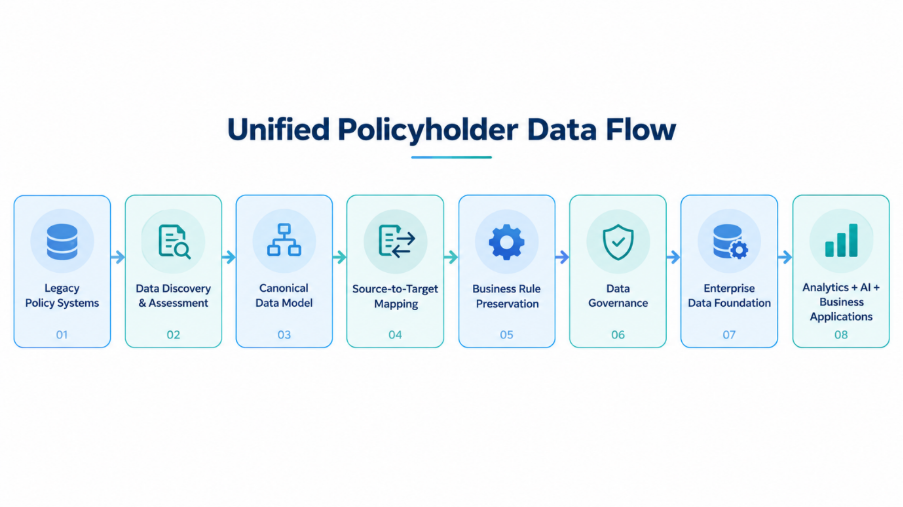
Each layer moves the organization from source understanding to preserved business meaning and governed access. Together, they turn insurance data integration into a repeatable enterprise capability.
How Optisol’s DataForge Can Help
OptiSol’s iBEAM DataForge is designed for modernization programs where understanding complex source environments is one of the hardest parts of transformation.
Its capabilities include – Data Sources’ Assessment, Canonical Data Modelling, Source-to-Target Mapping, Business Rule Extraction, & Code Artefact Generation
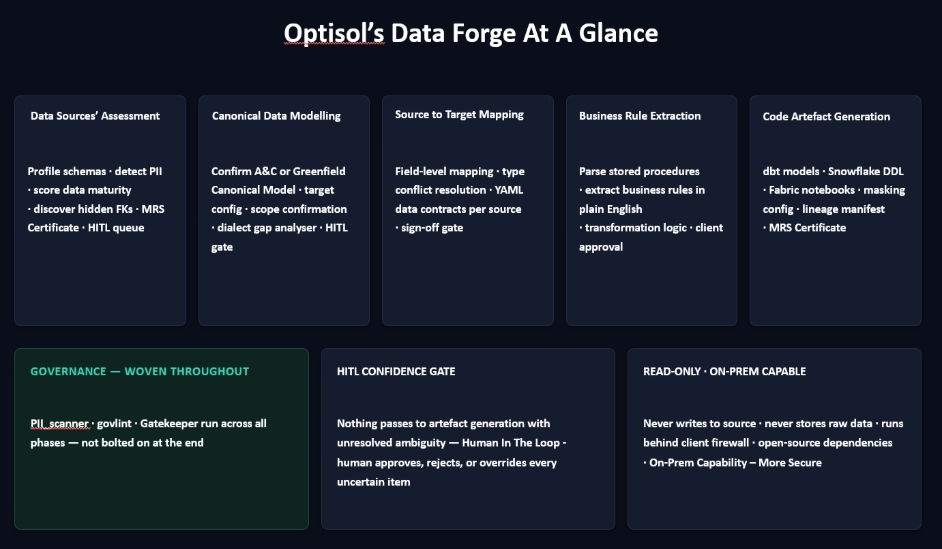
For insurers combining data estates, these capabilities provide a structured path from discovery to a governed foundation. Teams can assess sources, establish common models, define mappings, surface embedded rules, and formalize data expectations.
This approach supports insurance data modernization by creating reusable assets. It also strengthens insurance data migration by connecting technical transformation decisions to business meaning and gives insurance M&A data integration teams a repeatable framework for future acquisitions.
Learn more about iBEAM DataForge and OptiSol’s enterprise data modernization approach.
Business Value of a Unified Policyholder Foundation
A defined model, mapping framework, and rule inventory can reduce uncertainty around acquired data. Shared definitions can improve service, claims, underwriting, reporting, and auditability while reducing duplicated transformations and reconciliation.
Trusted data can support claims analytics, fraud detection, underwriting, customer intelligence, and AI agents.
These outcomes show how insurance data modernization can turn an acquisition into an enterprise data foundation for future growth and AI.
Conclusion
A policyholder data platform is an M&A business capability rather than simply a migration destination.
Start with source understanding. Establish common business meaning. Map the data carefully. Preserve business rules. Govern the combined environment.
When these disciplines work together, insurance data integration becomes a path toward a trusted enterprise data foundation. Insurance data migration becomes safer because context, rules, and relationships travel with the records.
The result is a trusted data foundation that can support operations today and analytics and AI tomorrow, with insurance data integration managed as an ongoing enterprise capability.
OptiSol helps insurance organizations assess complex data estates, uncover business logic, create common data models, establish mappings, and build governed foundations for analytics and AI.
FAQs:
How do insurers integrate policyholder data after an acquisition?
Start with source discovery and profiling, define a canonical model, map source data, preserve business rules, and establish governance. Effective insurance data integration also requires attention to historical records, lineage, privacy, and validation.
What are the biggest data challenges in insurance M&A?
Common challenges include different identifiers, schemas, claims structures, duplicate records, data quality gaps, and undocumented business logic.
How does post-acquisition data integration support AI?
Consistent, governed, traceable data reduces repeated reconciliation and gives AI teams clearer access to trusted inputs. This makes insurance data integration part of the foundation for scalable AI use cases.
