

Most organizations trying to put AI on top of their analytics take one of two routes, and both disappoint. The first is to point an AI model directly at the database and let it write its own queries. It sees tables and columns and produces confident answers, but it does not know the business rules, which columns are unreliable, what revenue actually excludes, which joins quietly duplicate rows, so some of those answers are wrong, and no one can tell which.
The second is to bolt a chat box onto an existing BI tool, where the assistant can only describe the charts already on the screen and cannot answer anything beyond them. Both routes fail for the same reason, and it is not a model problem: the AI has no reliable model of what the business means. That missing model is an architecture problem, and it is why AI ready data is really a question about how the whole analytics stack is built, not about which model you bolt on at the end.
Underneath that sits an older problem every data leader knows. A single key number, gross margin, net revenue, denial rate, is defined in several places at once: a warehouse view, a handful of spreadsheets, and someone’s memory. Two reports disagree, and reconciling them takes days. Every new question becomes a ticket for the data team, different teams quote different figures for the same metric, and data gets exported, cleaned, and re-uploaded by hand every reporting cycle. Adding an AI on top of that foundation does not fix it; it industrializes it, because now a confident machine is generating answers from the same ambiguous definitions, faster than anyone can check. A weak data architecture was tolerable when humans were the slow checkpoint. It is not tolerable once an AI is answering and acting at speed.
This is why the conversation is shifting from models to modern data architecture. Capable models are now available to everyone, so the differentiator is no longer the model; it is whether the data beneath it is structured, governed, and defined well enough for the model to reason on. Organizations that want trustworthy decision intelligence, answers a leader can actually act on, are discovering that it depends almost entirely on the architecture between the raw data and the decision, and that most analytics stacks were never built with an AI consumer in mind.
This blog sets out what an AI-ready analytics architecture should look like, from data to decision. It covers why the two common approaches fail, the layers the architecture actually needs, why the semantic layer is the piece most stacks are missing, and what a well-built architecture delivers that a bolted-on AI cannot. It is written for the data, analytics, or platform leader who has to make AI answers trustworthy enough for the business to rely on.
The Layers an AI-Ready Analytics Architecture Needs
An AI-ready analytics architecture is best understood as a stack that carries data up to a decision, with each layer doing a job the layer above depends on. It is not fundamentally different from a sound enterprise data architecture, but it adds one layer most stacks are missing, and it holds every layer to the standard of being safe for an AI, not just a human, to consume.
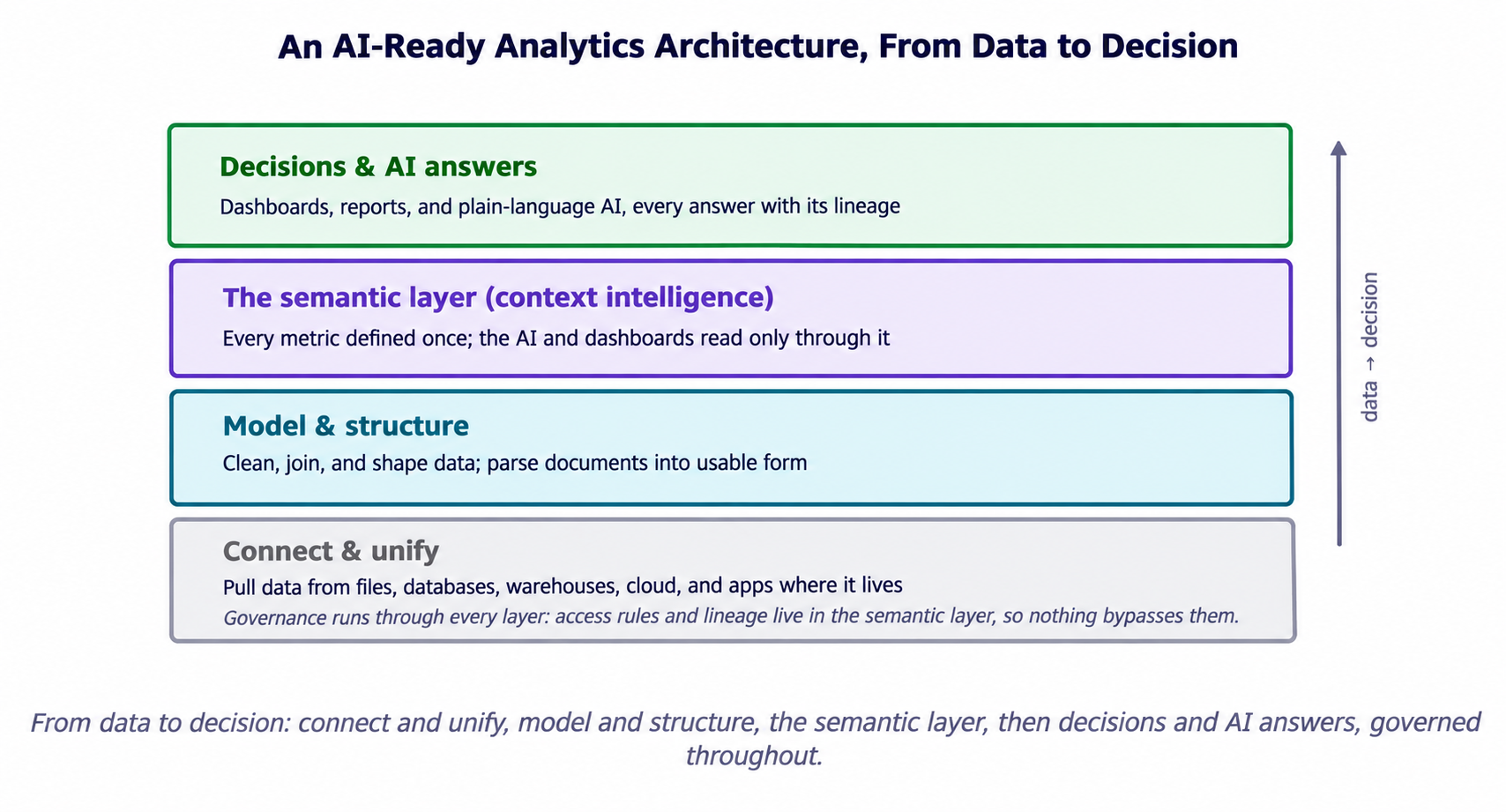
At the base is connect and unify: pulling data from wherever it lives, files, databases, data warehouses, cloud storage, and business applications, into one place it can be worked with, rather than leaving it stranded in silos. Above that is model and structure: cleaning, joining, and shaping the data into a reporting-ready form, and parsing documents and other unstructured content into usable data, the work a real AI data pipeline does rather than a demo shortcut. Then comes the layer most stacks lack, the semantic layer, which we will come to next. And at the top sit the decisions themselves: dashboards, reports, APIs, and a plain-language AI assistant, each reading through the layers below so that what they return is consistent and explainable. Governance is not a separate box bolted to the side; it runs through the stack, with access rules and lineage living in the semantic layer so nothing can bypass them.
The Semantic Layer: The Piece Most Stacks Are Missing
The layer that separates an AI-ready architecture from an ordinary one is the semantic layer, and it is the single most important idea here. A semantic layer is where every business metric is defined once, what it calculates, how it aggregates, which time grains it supports, and who is allowed to see it, and where every consumer, dashboard, report, API, and the AI, reads that one definition. There is no path that bypasses it. The AI cannot invent a different definition of gross margin, because only one definition exists, and it lives in the layer the AI is required to read through.
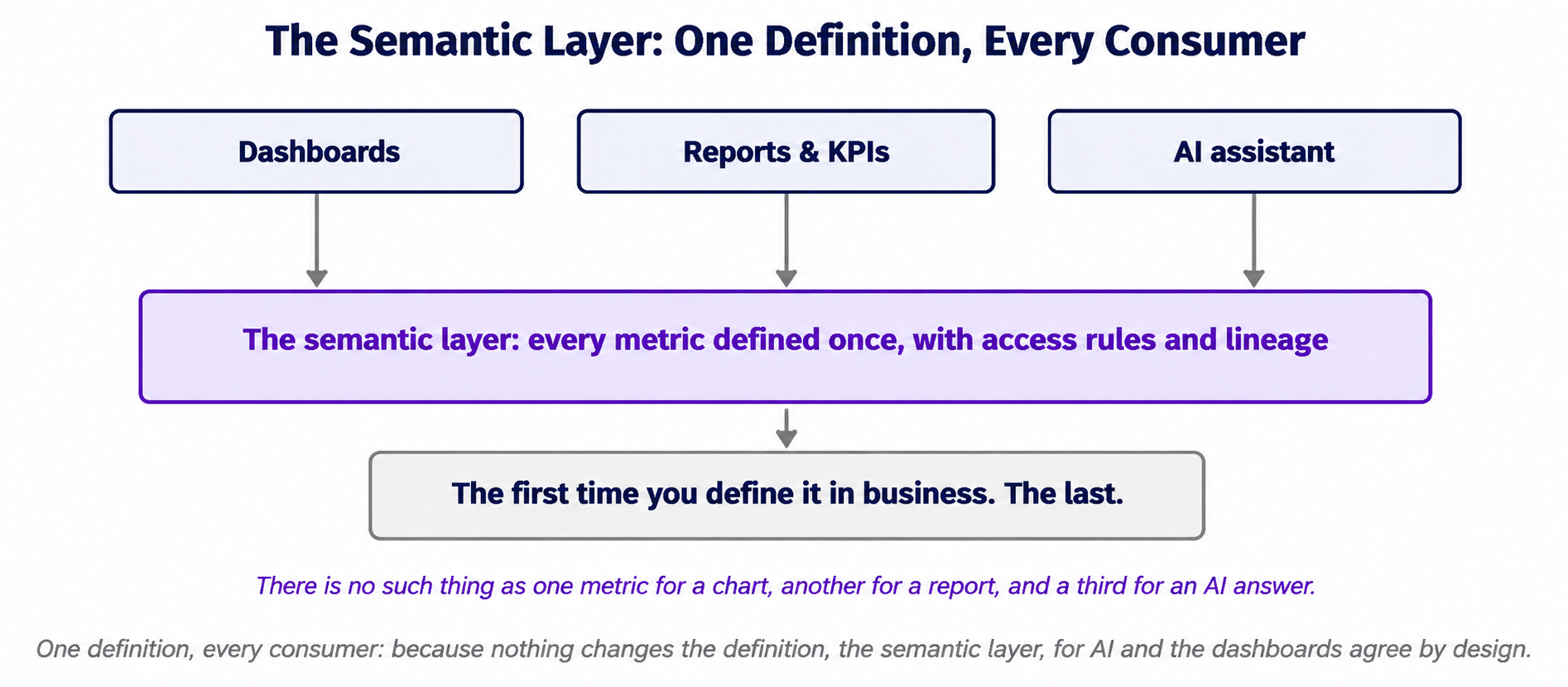
This is the fix for the root cause behind both failing approaches. Pointing an AI at the database fails because the AI has no model of the business; the semantic layer is that model. Bolting a chat box onto BI fails because the assistant is trapped in the dashboard; the semantic layer lets the AI answer any question the metrics support, not just the charts on screen. It is also where a knowledge graph and the relationships between entities add context, so the architecture understands how the pieces of the business connect rather than just storing values. Put simply, the semantic layer is the reliable model of meaning that makes an AI answer trustworthy, and it is precisely the layer that most analytics stacks, built for human analysts who carried the definitions in their heads, never formalised.
What a Well-Built Architecture Delivers
The reason this architecture is worth building is not elegance; it is four concrete properties that a bolted-on AI cannot provide, and that a business needs before it will trust an AI answer enough to act on it.
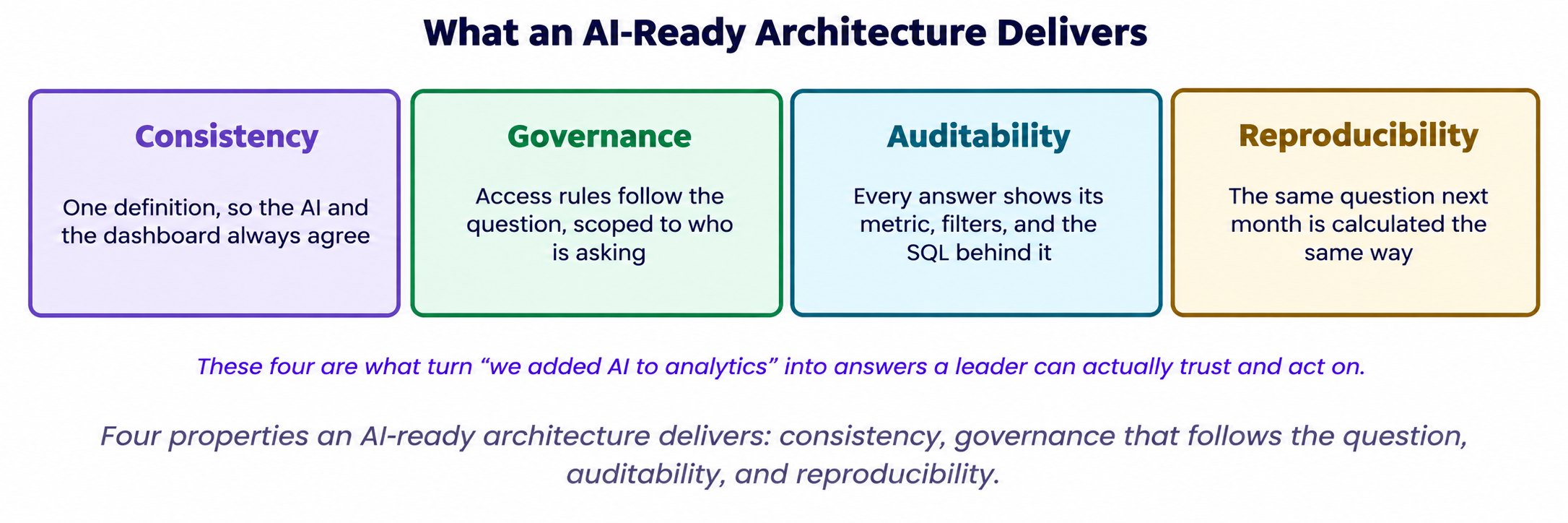
The first is consistency: because the AI and the dashboard read the same definition, they agree by construction, and the AI cannot quote a different number than the report. The second is governance that follows the question: access rules live in the semantic layer, so a regional manager asking the AI automatically gets an answer scoped to their region, without a separate access model per tool. The third is auditability: every answer can state its lineage, the metric, the filters, and the SQL behind it, so a leader can see where a number came from, which is what finally makes AI answers trustworthy in a regulated setting. And the fourth is reproducibility: the same question next month is calculated the same way, because the definition is a version-controlled file, not a prompt that drifts. Together, these capabilities turn AI-enabled analytics into something the business can rely on, which is the entire point of building a data foundation for AI in the first place.
Building It on What You Already Have
A common and reasonable fear is that an AI-ready architecture means ripping the data warehouse and starting over. It does not. A well-designed layer sits on top of the warehouse, databases, cloud storage, and applications an organisation already runs, connecting to the data where it lives and adding the semantic layer, the dashboards, and the AI on top, without moving the warehouse.
Existing BI dashboards can be rebuilt into it gradually, with AI exploration added on top, so nothing is lost in the transition. That is what makes this a data for AI architecture an enterprise can actually adopt: it is additive, and it can start with one high-value area, denials in revenue cycle, wasted spend in advertising, a single decision that is slowed by waiting on reports, rather than boiling the ocean of the whole data estate.
The same architecture has been applied across very different settings, healthcare revenue cycle, consumer-goods advertising analytics, and migrating an enterprise off an older BI tool, following the same repeatable pattern each time, which is what distinguishes an architecture from a series of custom projects. Governance, lineage, and masking of personal data are built into the layer, so the same stack that makes answers trustworthy also keeps regulated data safe, with the AI acting under each user’s own permissions and the organisation choosing which model provider it uses.
Architecture First, Then Intelligence
The organisations that get trustworthy answers out of AI are not the ones with the most advanced model; they are the ones that built the architecture the model needed, a stack that connects the data, structures it, defines every metric once in a governed semantic layer, and serves that single definition to every dashboard, report, and AI answer. Start from the model and you get confident answers no one can verify. Start from the architecture, and the model becomes the easy part on top of a foundation the business can trust.
The architecture, the elsai Platform provides through its data foundation is what all you need. It connects to the data wherever it lives, structures it, and adds a governed semantic layer, context intelligence, so that dashboards, reports, APIs, and the AI all read through one agreed definition of every metric, every answer carrying its lineage and scoped to who is asking. It sits on top of the warehouse and systems you already run rather than replacing them, keeps regulated data governed and masked, and lets you bring your own model and your own infrastructure, with every action traceable through elsai observe.
It is proven across healthcare, advertising analytics, and BI migrations on the same repeatable pattern, and it is what makes an enterprise ai agent platform and the agentic ai platforms enterprise knowledge management built on it give answers a leader can act on. For a data or analytics leader who wants AI that the business will trust, start with the architecture, not the model.
FAQs:
Why do AI analytics projects fail when the data is already in a warehouse?
Because a warehouse holds the data but not the meaning. Pointing an AI at warehouse tables lets it write its own SQL without knowing the business rules, so it produces confident answers that are sometimes wrong. The missing piece is a governed semantic layer that defines what each metric means, which the AI must read through, so its answers match the organisation’s own definitions rather than its guesses.
What is a semantic layer, and why is it the key to an AI-ready architecture?
A semantic layer is where every business metric is defined once, its calculation, aggregation, time grains, and access rules, and where every dashboard, report, API, and the AI reads that single definition. It is the key piece because it gives the AI a reliable model of what the business means, so the AI and the dashboards agree by construction and the AI cannot invent a different definition of a number.
Does an AI-ready analytics architecture mean replacing our data warehouse or BI tool?
No. The architecture sits on top of the warehouse, databases, and applications you already have, connecting to the data where it lives and adding the semantic layer, dashboards, and AI without moving the warehouse. Existing BI dashboards can be migrated gradually with AI exploration added on top, so the transition is additive and nothing is lost.
How does this architecture make AI answers trustworthy and auditable?
Because every answer reads through the semantic layer, it can state its lineage, the metric, the filters, and the SQL that produced it, so a leader can see exactly where a number came from. Access rules in the same layer scope each answer to who is asking, personal data is masked before it reaches a model, and definitions are version-controlled, so the same question is answered the same way over time. Consistency, governance, auditability, and reproducibility are built in.
Where should we start, rather than rebuilding our whole data estate?
Start with one high-value decision area, for example denials in revenue cycle or wasted spend in advertising, rather than the full estate. Connect that area’s data, define its metrics in the semantic layer, and enable the AI on it, so a focused win builds trust in the numbers quickly. Because the pattern is repeatable, you can then extend the same architecture to the next area without starting over.
