


BLUF. Human oversight is 70 to 75 percent of what it costs to run an agent. Tokens are 20 to 25 percent. Enterprises are negotiating the small slice and have assigned nobody to the large one. The three roles I wrote about last month turn out to be the three places where agent cost is actually decided, making cost discipline in agentic operations a question of organization design rather than procurement.
QuantumBlack’s analysis of agentic workflow economics, published by McKinsey in August 2026, puts human oversight at 70 to 75 percent of the variable cost of running an agent. Token costs account for 20 to 25 percent.
So an enterprise that negotiates 20 percent off its token bill has cut the cost of running that agent by roughly four percent. Fixed costs, meaning AI infrastructure and the data science capacity to keep an agent working in production, add a further 25 to 30 percent of annual run cost on top.
Almost every procurement conversation I see about agentic AI is about the four percent.
The expensive part is people reviewing agent output
Somebody with functional or risk expertise reads what the agent produced and decides whether it can proceed. In bank customer onboarding, the McKinsey analysis expects 10 to 20 percent of agentic runs to be reviewed by a risk or functional expert. Those reviews consume expensive hours, recur across runs, and scale with volume in a way token costs do not.
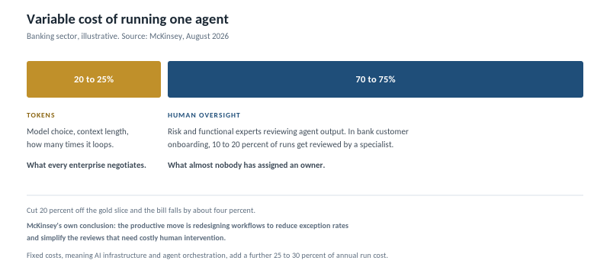
The authors reach a conclusion worth quoting directly, because it runs against where most optimization effort goes. Organizations focus on model selection and token costs because they are the most visible expenses. A more productive approach is to redesign workflows to reduce exception rates and simplify costly human review.

Mid-market operations sit at the wrong end of the volume curve
Agent economics reward volume, and they reward it steeply. The same analysis puts the cost per run at $78 to $79 at a hundred runs a year. At 2,500 runs it falls to $4 to $5. At ten thousand runs it reaches $2 to $3. Onboarding 2,500 new customers costs $10,000 to $15,000; doubling the customer count raises that only to $15,000 to $20,000, because the fixed costs are already paid.
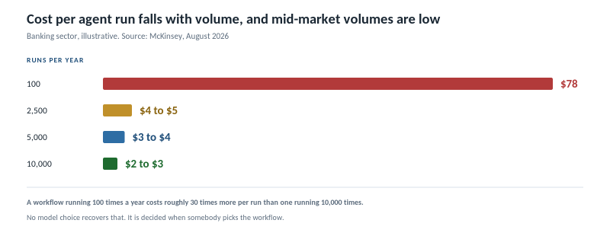
For a mid-market operations leader, that curve says something uncomfortable. A bank onboarding tens of thousands of customers a year lives at the cheap end by default. A manufacturer qualifying two hundred suppliers a year, or a provider group handling a few thousand prior authorizations, lives much closer to the expensive end.
The absolute figures tell a different story. McKinsey’s analysis puts the cost of running a single customer-facing agent workflow in banking at $20,000 to $30,000, and a multiagent team at $100,000 to $200,000. At a bank those are operating details. At a company with $50 million of revenue, the second number is the entire AI budget for the year.
The three roles are the three cost levers
Last month I wrote that a mid-sized enterprise needs three roles to get agents into production: an AI Product Manager, an AI Forward Deployed Engineer and an AI Technology Leader. Read against these economics, those three roles stop looking like a staffing model and start looking like a cost structure. Each one owns a different part of the bill, and together they influence the 70 to 75 percent spent on human oversight.
| Role | The cost it decides | Why it is the lever |
|---|---|---|
| AI Product Manager | Which workflow, at what volume | Workflow selection sets your position on the volume curve before a line of code exists. Choosing a hundred-run workflow over a ten-thousand-run one is a thirtyfold cost decision that no amount of model tuning recovers. Scoping discipline is therefore a financial decision. |
| AI Forward Deployed Engineer | Exception rate and review design | Evaluations, connectors, skills that encode how your team handles the awkward cases: all of it exists to reduce the share of runs a specialist has to read. That share is what drives the 70 to 75 percent oversight cost. |
| AI Technology Leader | Attribution, autonomy limits and cadence | Measure cost per completed case, not per month; define which decisions the agent can make alone, since every escalation adds human cost; and establish a review cadence to track changes in agent economics. |
The uncomfortable version of this is that if oversight is three quarters of your run cost, then the people who design oversight are the highest-leverage cost lever available, and they are the ones nobody is negotiating with.
Cost per agent tells you almost nothing
The metric the analysis lands on is what it calls completed work ROI: the fully loaded cost to finish the job, with humans, agents and deterministic systems included, measured against the value produced.
Their worked example is a retail customer opening a bank account. Completing that one journey involves five to seven agents, more than three deterministic rules engines, and two to four teams of people providing subject matter expertise, evaluating agent output and running detailed checks on high-risk cases. The total cost to complete the onboarding falls from roughly $50 to $150 per customer to roughly $10 to $30.
A single agent inside that picture can look cheap or expensive and say nothing useful about whether the workflow pays. The unit that carries meaning is one finished piece of work: a resolved claim, a qualified supplier, an authorization decision that stands.
Which is why the first thing we ask a client for is the current cost of completing one case, before anything gets built. A baseline captured afterwards is a reconstruction, and reconstructed numbers are harder to defend during budget reviews.
Budget for the second year, not just the build
Traditional software projects settle down after go-live. Agentic workflows do the opposite. The analysis notes that production agents often need adjusting every couple of days as foundation models, protocols, enterprise systems and business requirements move underneath them, and that a change in regulation or internal risk appetite can force an agent to be reevaluated, modified or paused outright.
Two practical consequences follow. Any business case that funds the build and not the evolution is understating the cost of the thing it just approved. And an agent whose economics were attractive in March can become uneconomic by September without anyone doing anything wrong, which means somebody has to be looking.
McKinsey recommends building an AgentOps capability with a management cadence, similar to how finance teams use FinOps to manage cloud spend, and putting AI unit economics into quarterly business reviews. That gives leadership the visibility to see which workflows still justify their spend and which should be redesigned, consolidated or moved to a cheaper model.
Four numbers to put in front of your next review
None of these require a platform decision, and all four are answerable from what your teams already know.
| The number | What it tells you |
|---|---|
| Runs per year, per workflow | Your position on the volume curve. Below a few hundred runs, the arithmetic is probably against you whatever the demo looked like. |
| Share of runs that a specialist reviews | Your exposure to the 70 to 75 percent. This is the number to attack, and most operations have never measured it. |
| Fully loaded cost to complete one case | The only figure that tells you whether the workflow pays. Capture it before you build, not after. |
| Cost of keeping the agent working, per year | Infrastructure, orchestration and the engineering time required to keep it current. These costs are absent from most business cases. |
A caution on the figures in this piece. They come from banking-sector analysis and are explicitly illustrative. Your oversight ratio will differ, and a shipbuilding procurement function with export-controlled data will differ a great deal. Treat them as the shape of the problem and measure your own numbers against that shape.
What this changes about how you buy
If token price were the dominant cost, agentic AI would be a procurement exercise. You would negotiate rates, commit to volume, and manage the contract.
Because oversight is the dominant cost, it becomes a question of how the work is organized: which workflows you choose, how many runs actually need human review, who is allowed to decide what alone, and who is watching the economics change. All four of those are decisions people make, and they need names against them.
The three roles are what gets an agent into production. They are also what makes it affordable to keep it there.


